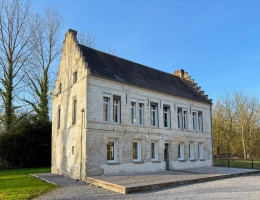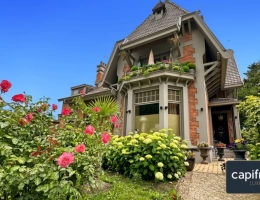
A maison de maître for sale in Nord stands out from afar by its red brick trimmed with white stone, its tall lintelled windows and its front steps: this is the house built by the spinners, brewers and merchants of Lille, Roubaix, Tourcoing and Valenciennes at a time when textiles and coal made the region's fortune. This section goes beyond them: it brings together all the fine residences of the department, seaside villas of the Flemish coast, architect-designed houses and contemporary estates included, as soon as the living space exceeds 300 m² or the price nears a million euros, apart from chateaux, manor houses and historic monuments. Browse the maisons de maître and fine residences for sale posted by private owners, agencies and notaries in Nord.
Below you will find real price benchmarks for the department's large houses, the profile of the properties currently on the market, the particularities of brick and blue stone, the areas where these houses cluster and the checks to make before an offer, in particular on former mining ground and along the coast. To structure each stage of your project, rely on our guide to buying prestige property in France.
Maisons de maître form the core of the segment tracked by our observatory: houses with more than 300 m² of living space on 0.05 to 10 ha, sold above €1,000 per m², recorded in the DVF database of the French tax administration. These benchmarks frame the market for large residences without describing it entirely: a small village bourgeois house or a chateau sold with 30 ha of parkland fall outside this scope.
In Nord, 161 sales were recorded from 2021 to 2025, with a median price of €732,200, a floor/ceiling range (P10–P90) of €412,000 to €1,338,500 and a median of €2,080/m² of living space, for an average of 357 m² of living space and 5,031 m² of land. Across the Hauts-de-France region, the 2025 median stands at €756,800* (79 sales), against €822,000 in France in 2025 (981 sales).
| Scope | Sales | Median price | Floor – ceiling (P10–P90) | €/m² living space (median) |
|---|---|---|---|---|
| Nord (2021-2025) | 161 | €732,200 | €412,000 – €1,338,500 | 2,080 |
| Hauts-de-France (2025) | 79 | €756,800* | €399,800 – €1,602,000 | 2,131 |
| France (2025) | 981 | €822,000 | €428,000 – €3,100,000 | 2,308 |
The breakdown by stratum (coastal, rural tourist, ordinary rural) and the five-year trend are in our observatory of prestige property prices in France (in French). Before making an offer, work out purchase costs and borrowing capacity with our financial tools and calculators.
Source: DVF (DGFiP), transactions from 1 January 2021 to 31 December 2025, processed by ma-propriete.fr; prices rounded to the nearest €100. * Fewer than 100 sales: read as an indication only.
As of 28 September 2026, the section lists 5 properties in the Hauts-de-France region, on which this page falls back for lack of enough listings in Nord, at a median asking price of €1,199,000 (average €1,115,800); 80% of properties are offered between €795,000 and €1,360,000, for a median living space of 468 m² on 0.5 hectare of land, or €2,671 per m² of living space. These are asking prices, before negotiation; they compare with the actual sale prices in the previous section, which are generally lower.
| Asking price | Listings | Share |
|---|---|---|
| €500,000 to €800,000 | 1 | 20 % |
| €800,000 to €1.2M | 2 | 40 % |
| €1.2M to €2M | 2 | 40 % |
Statistics calculated on the listings published in the section on 28 September 2026; they change daily with new listings and withdrawals.
Red brick fired in the region's kilns remains the dominant material: laid in careful bond, it is picked out with quoins, string courses and window surrounds in white stone or in the blue stone of the Avesnois. The maisons de maître of the textile owners, in Roubaix, Tourcoing, Marcq-en-Barœul or Croix, show façades of three bays, Mansard slate roofs, iron-and-glass verandas and large reception rooms opening one into the next. In Dunkirk, Malo-les-Bains and as far as Bray-Dunes, the fine residence becomes a timber-framed seaside villa with balconies; in the metropolitan area it also takes the form of architect-designed houses and contemporary properties set in gardens.
Outbuildings are part of the setting: stables and coach houses from the days of horse-drawn carriages, a caretaker's cottage, a glasshouse, an orangery, sometimes a former factory lodge converted into a studio. Older houses keep their cement tiles, herringbone parquet floors, marble fireplaces, panelling and moulded ceilings, while recent builds offer large glazed openings, an indoor pool or a pool house at the end of a park enclosed by hornbeam hedges.
The Mélantois and the Pévèle, around Lille, Marcq-en-Barœul, Bondues and Phalempin, gather the most sought-after bourgeois houses, right next to the metropolis. The Douaisis and the Valenciennes area, with Douai, Orchies and Valenciennes, offer notables' houses, mining engineers' residences and former merchants' homes at more moderate prices. The Cambrésis, around Cambrai and Le Cateau-Cambrésis, and the Avesnois, from Maubeuge to Le Quesnoy via Avesnes-sur-Helpe, offer hedged farmland, blue stone and larger properties. Inland Flanders, between Cassel, Hazebrouck and Bailleul, appeals with its hills and its country houses.
On the coast, Dunkirk, Malo-les-Bains and Zuydcoote make up a small market of seafront villas, tighter than the hinterland. The Lille-Europe and Lille-Flandres stations put Paris and Brussels within reach of a direct train, and the A1, A22, A23 and A25 motorways link the various areas of this densely built department quickly: buying in the Avesnois often means choosing space, buying near Lille means choosing proximity.
The subsoil of Nord bears the mark of coal mining: in the Douaisis and the Valenciennes area, the risk of subsidence or ground movement must be checked in the risk statement, since it can weigh on the foundations of a large house. The clays of Flanders cause cracks and ground movement in dry spells, while old brick calls for monitoring of joints, rising damp and chimney stacks. On the Flemish coast, the Loi Littoral and the marine flood prevention plans govern extensions to villas; in the valleys of the Scarpe, the Escaut and the Sambre, flooding means you should ask about past high-water episodes.
Industrialists' houses sometimes include outbuildings used as workshops, whose conversion requires checking the land's zoning and any soil pollution. For a recent property, have someone confirm that the veranda, the pool and the annexes match the planning permissions and the ten-year building guarantee. A building expert appointed before the preliminary sales agreement will spare you surprises on slate roofs and roof timbers.
Listings of maisons de maître and fine residences in Nord come from private owners, specialist agencies and notaries' offices; sort them by budget, living space, plot size and outbuildings, then create an e-mail alert so that every new property reaches you. To widen your search to neighbouring departments, browse the maisons de maître and fine residences for sale in Hauts-de-France.