

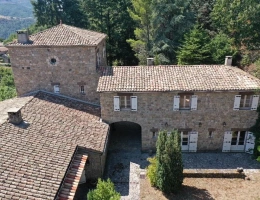
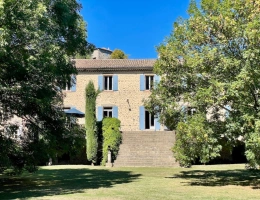

A chateau for sale in Ardèche is most often found along the Rhône valley, in the gorges to the south or on the volcanic heights of the Vivarais, a department where rugged terrain has long limited the size of large residences and shaped a scattered pattern of small hamlets clinging to the hillsides. Buyers find fortified houses in dark volcanic stone or pale limestone depending on the massif, former chestnut-grove farmhouses converted into residences, and a handful of pleasure chateaux built by notable families beside the river. Browse every chateau for sale listed by private owners, agencies and notaries across Ardèche.
This page brings together real price benchmarks for these properties, the areas where they cluster, the character of local building in volcanic stone and limestone, and the checks worth making before an offer on a property often secluded on rugged terrain, far from the main roads and public services. To plan a full heritage purchase, read our guide to buying prestige property in France.
DVF land registry data does not identify chateaux as such: the benchmarks below cover sales of houses over 300 m² of living space on 0.05 to 10 ha, above €1,000/m², tracked by our observatory. They frame the market for large residences without describing it entirely: an estate with 30 ha of parkland or a listed monument sold with its farmland falls outside this scope.
The local market is too thin to publish a reliable department-level benchmark (28 sales in five years): we give the figures for the Auvergne-Rhône-Alpes region. Across the Auvergne-Rhône-Alpes region, the 2025 median stands at €860,000* (87 sales), against €822,000 in France in 2025 (981 sales).
| Scope | Sales | Median price | Floor – ceiling (P10–P90) | €/m² living space (median) |
|---|---|---|---|---|
| Auvergne-Rhône-Alpes (2025) | 87 | €860,000* | €492,700 – €2,670,000 | 2,542 |
| France (2025) | 981 | €822,000 | €428,000 – €3,100,000 | 2,308 |
The breakdown by stratum (coastal, rural tourist, ordinary rural) and the five-year trend are in our observatory of prestige property prices in France (in French). Before making an offer, work out purchase costs and borrowing capacity with our financial tools and calculators.
Source: DVF (DGFiP), transactions from 1 January 2021 to 31 December 2025, processed by ma-propriete.fr; prices rounded to the nearest €100. * Fewer than 100 sales: read as an indication only.
The north and centre of the department, on the foothills of the Massif Central, offer buildings in dark volcanic stone, basalt or lava, which give façades the grey-to-black tone typical of the Vivarais. Further south, towards the Ardèche gorges, pale limestone predominates, with stone-slab or canal-tile roofs depending on altitude. Residences are often arranged in successive terraces set against the slope, with dry-stone retaining walls supporting gardens, chestnut orchards and former restanque cultivation.
Properties for sale frequently include outbuildings: former silkworm-rearing sheds once used for silk farming, chestnut-drying huts known locally as clèdes, and small rural chapels now converted into sitting rooms or offices. The condition of the stone-slab roofs, which weigh heavily on the roof timbers, and the stability of dry-stone walls on sloping ground are among the most common points to watch on this rugged terrain, along with the state of the timber supporting each terrace.
The Rhône valley, around Aubenas and Privas, holds the largest number of the best-connected properties, while the Vivarais and the Monts d'Ardèche, further inland, offer secluded residences in a mid-mountain volcanic landscape. To the south, the Ardèche gorges area, around Vallon-Pont-d'Arc and Ruoms, combines built heritage with nature tourism and heavy summer visitor numbers. The north of the department, more rugged, near Le Cheylard and Lamastre, remains a discreet district where properties trade at more measured prices, far from the tourist bustle.
The department has no TGV station; rail access runs via Intercités and TER links to Valence TGV station, just across the border in Drôme, about thirty minutes' drive from Privas. The A7 motorway runs along the eastern edge of the department beside the Rhône, giving quick access to the riverside communes. Areas close to the Rhône valley remain the most sought-after, while the mountainous north and the most remote hamlets stay more affordable.
A few fortified houses and chateaux in Ardèche are listed historic monuments, notably along the Rhône valley; check this status before planning any exterior works, even a simple façade repaint. On sloping land, often terraced into restanques, the stability of retaining walls and the risk of ground movement should be assessed by a professional before any offer, as should rights of way and access easements specific to clustered hamlets.
On the technical side, have the stone-slab roofs checked, since their weight calls for a robust roof structure, along with the drainage arrangements of secluded properties, very often not connected to a collective network in this rural department. Access during the long summer drought periods common on the limestone massifs also deserves to be planned for in terms of the water supply and any private catchment.
Chateau and residence listings in Ardèche are published by private owners, specialist agencies and notaries; filter them by price, living space, land area or proximity to the Rhône, then set up an e-mail alert to track new properties as soon as they come to market. Widen your search across the whole region with the chateaux for sale in Auvergne-Rhône-Alpes, from the volcanic uplands to the Alpine valleys.


