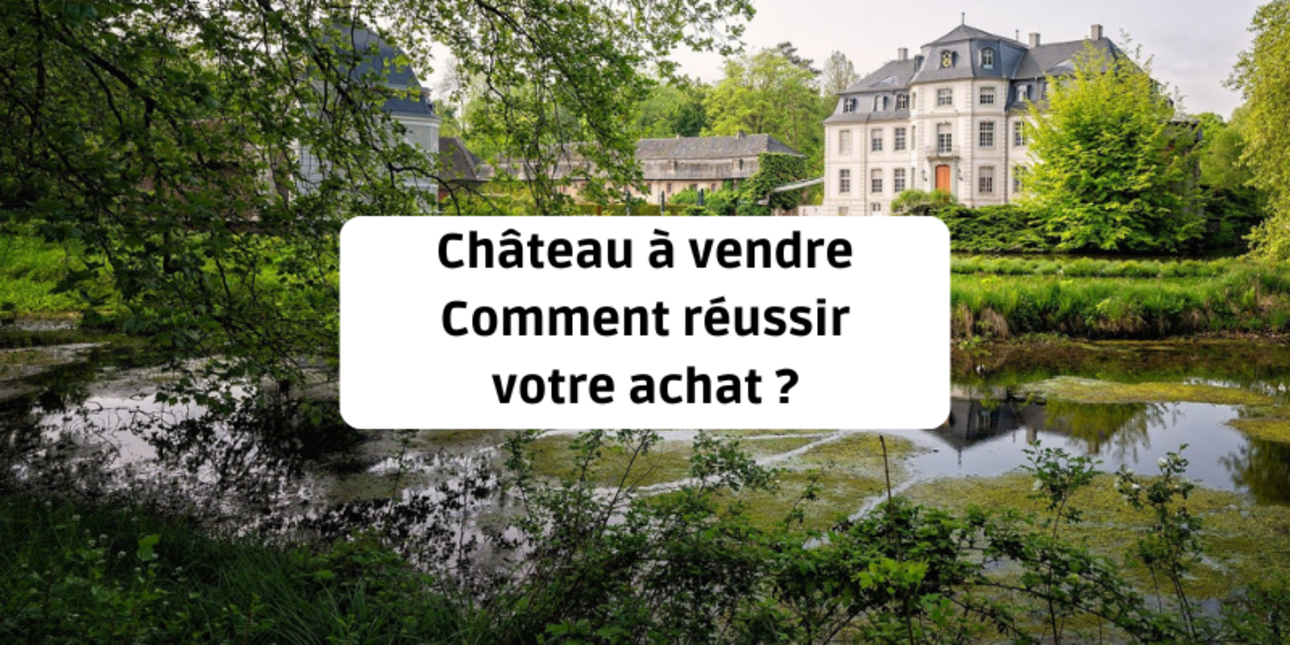
Acquiring a château or a manor house means coming within reach of a rare dream: becoming the guardian of a seigneurial residence, of a centuries-old landscaped park, and sometimes of an entire chapter of local history. Yet behind the picture-postcard image (moats, outbuildings, period roof timbers, slate roofing) lies an acquisition reality very different from "standard" real estate: heritage requirements, sharp technical expertise, operating budget, legal structuring… and often, confidentiality of transactions.
As part of our buyer's guide to prestige properties for sale, acquiring a château fits within an overall approach: defining your project, securing the market value, anticipating works, structuring the inheritance transfer, and gaining serene access to a niche market frequented by international buyers (HNWIs) and families in search of a lasting legacy.
Even before viewing, the most strategic question is simple: what is your château meant to be used for? In prestige real estate, the intended use governs almost everything: location, budget, level of restoration, regulatory constraints and business model. A classic mistake is to "fall in love" with a place, then discover that the intended use (welcoming the public, running prestige hospitality, hosting weddings) requires far heavier works and authorisations than expected.
For private use, a château is often conceived as a family house: a place for holidays, intergenerational reunions and total disconnection. You are no longer simply buying square metres, but a French art of living: tree-lined driveways, walled garden, silence, privacy, and sometimes private hunting on the estate.
Within this logic, your criteria must be very concrete:
Accessibility first: an isolated château can be magical… and unmanageable if every trip becomes an expedition. Next, maintainability: a monumental floor area, numerous outbuildings and a centuries-old landscaped park entail recurring upkeep costs. Finally, family coherence: who occupies it, who maintains it, who finances it, and how the future inheritance transfer will be organised (this point becomes central as soon as several heirs are involved).
Many owners choose (or have to choose) an economic valorisation: luxury guest rooms, a reception estate, high-end events (weddings, seminars), or prestige hospitality. This reasoning is in no way contradictory with safeguarding historic heritage: on the contrary, a healthy business model is often the condition for maintaining the property over the long term.
But you must be clear-headed: welcoming the public changes the nature of the project. As soon as a place becomes an ERP (Public-Access Establishment), safety and accessibility requirements apply (categories and types of ERP, fire-safety obligations and access for people with disabilities).
In practice, this affects the layout of circulation routes, staircases, exits, signage, and sometimes heritage choices that must remain compatible with the historic character.
If your project is limited to the "guest rooms" format, France also regulates the activity: it is notably limited to 5 rooms and 15 guests at the same time, with minimum services and a declaration to be filed.
Finally, some châteaux are tied to a terroir or a strong territorial anchoring: vineyard, orchard, large rural property. In these cases, winegrowing or farming (even partial) can contribute to the balance. The key point is to align the project with the technical reality of the place: what the site allows, what the regulations allow, and what your family wants over 10–20 years.
This dimension is often underestimated by buyers discovering the market. A château is not merely a "beautiful house": it is a heritage and cultural asset, sometimes protected, almost always demanding, and fundamentally oriented towards the long term.
Buying a château very often amounts to a passion investment. This does not mean giving up all rationality; rather, it means that the decision criteria are not those of a rental studio: you are looking for a history, an architectural coherence, a soul, and the ability to embed the property within a family legacy.
This "passion" approach becomes a strength when it is well framed:
A vision of the inheritance transfer (who will inherit, how, under what conditions), a stable upkeep budget, and a transparent use strategy (private / mixed / commercial use). Without this, a château can become a source of tension, even for very well-structured families.
And it is precisely here that proper support changes everything: a specialised estate agent, an experienced notary, technical expertise in old buildings, and a tailor-made assessment of the market value (beyond the simple "price per m²").
In France, protection under historic monuments comprises two levels: inscription (the first level) and classification (the highest level). Classification entails a stronger level of requirement, in particular regarding the qualification of the professionals involved in restoration.
In practice, you will still often see the term ISMH ("Supplementary Inventory"): it corresponds to the notion of "inscribed", and many administrative documents use abbreviations such as ISMH/IMH for "inscribed" and CLMH for "classified".
This status is protective, but it entails rules:
Good news: this status also opens the door to State subsidies (via the ministry's services in the region). The average rates announced by the administration are around 40% for a classified building and 20% for an inscribed building, but the grant remains "a possibility and not a right": it depends on heritage priorities and available funds.
To check the exact situation of a property (inscribed, classified, partially protected, etc.), the public databases (Mérimée database / Open Heritage Platform) allow an official search.
Finally, be careful: even if your château is not protected, it may be located in the surroundings of a historic monument. In this case, works altering the external appearance may require the approval of the Architect of the Buildings of France (ABF), in particular within a delimited perimeter or, failing that, within the field of visibility of less than 500 metres; specific processing times apply.
How much does a château or large prestige estate cost?
According to our Observatory of prestige property prices (official DVF data, 7,068 transactions analysed between 2020 and 2025), a large prestige rural property sells on average for €1.23 million, with a median price of €773,000. The gap nevertheless remains considerable depending on location:
How much does a château or large prestige estate cost?
According to our Observatory of prestige property prices (official DVF data, 7,068 transactions analysed between 2020 and 2025), a large prestige rural property sells on average for €1.23 million, with a median price of €773,000. The gap nevertheless remains considerable depending on location:
View all price statistics by region and by department →
The "listing price" is only the beginning. To buy intelligently, you must reason in terms of total cost: acquisition + works + operation + upkeep + taxation + transmission. This approach is one of the strongest EEAT markers in prestige real estate: it protects the buyer and secures the project.
Before reasoning in terms of total cost, it is useful to situate the acquisition price relative to the market. According to the official data we analyse in our Observatory of prestige property prices, the average price of a large rural property stands at around €3,340/m² of living space nationally, but can exceed €7,500/m² on the tourist coastline. For a château, however, the listing price reflects only part of the reality: the value depends as much on the condition of the building, the park and the heritage status as on the floor area.
In a château, the main risks are not always visible during a viewing. The challenge is to prioritise the issues that can blow up a budget:
The roof (and in particular a slate roof); the condition of the period roof timbers; structural damp; masonry; networks; the heating of large volumes; the quality of drainage; and, depending on the region, certain biological pathologies of the building.
An important point, often forgotten: dry rot (mérule). In certain areas delimited by prefectural order, the sale of a built property may require disclosure of the dry-rot risk as part of the sale file.
Even outside these areas, the presence of wood-decay fungi or persistent damp must be seriously investigated (cellar, floors, woodwork, unheated areas).
Another particularity: if the property is classified or inscribed, the works logic is not the same. On a classified building, works "liable to affect the substance or appearance" of the classified part, or to jeopardise its conservation, fall within an authorisation regime, with a file and regulated timeframes.
On an inscribed building, works often fall under planning authorisations (permits, prior declaration) with the approval of the regional prefect.
Finally, do not rely solely on the "EPC" idea. Classified or inscribed historic monuments are among the cases where the energy performance diagnosis is not required; nevertheless, the issues of comfort, heating and energy optimisation remain very real, and must be addressed with solutions compatible with heritage constraints.
To go further, discover the essential steps to renovate a classified château or manor house according to best practice.
Once acquired (and possibly restored), a château lives on a daily basis. Upkeep costs are not a "detail": they shape the reality of life as a châtelain.
Without quoting figures blindly, you must build a budget in blocks:
Add to this the "transactional" cost at purchase: acquisition fees, transfer duties and notary fees vary according to the nature of the property and the department, with recent changes to transfer duties authorised until 2028 depending on local decisions.
In a heritage project, this initial budget must be calmly factored in from the outset, on the same footing as the works.
Finally, subsidies (if the property is protected) can support upkeep, repair, restoration or safety-improvement operations, but should be regarded as a "conservation-aid bonus", never as a financial certainty.
A successful acquisition rests as much on the financial architecture as on the beauty of the place. At this level, the objective is not merely to buy: it is to buy securely, with the right structure, the right taxation, and the right confidentiality strategy.
Three subjects advance together: structuring (own name, company), taxation (regimes, deficits, constraints), and transmission (gift, dismemberment, family pacts, etc.).
On a protected monument, France provides specific tax arrangements. The administration clearly recalls that these mechanisms are not designed as a "convenience" optimisation product, but as the counterpart to real charges borne to conserve a national heritage.
Concretely, depending on the property's situation (open to the public or not, generating revenue or not), certain property charges may be taken into account, and the property deficit linked to historic monuments may be deductible from overall income without any amount limit, subject to conditions (in particular a conservation commitment and holding conditions).
Be careful: holding through a family SCI may be relevant for organising governance and the inheritance transfer, but it must be set up intelligently because the "historic monuments" tax regimes carry conditions and exceptions depending on the mode of ownership.
On the transmission side, there is also a mechanism for exemption from free transfer duties for certain classified or inscribed properties, subject in particular to an agreement setting out the terms of upkeep and public access (depending on the case).
Since 2025, the tax administration has also published clarifications on the application of this arrangement to transfers of dismembered rights (which may be of interest for a dismemberment scheme).
Optimising the taxation of your luxury real estate will be a decisive step… but it must be steered on a case-by-case basis, with your notary and your advisers, because the taxation of monuments and family structures is technical and evolving.
Finally, do not forget the levers of aid and private mobilisation: the Fondation du patrimoine intervenes through donation drives, corporate patronage, direct aid and a label (issued after the ABF's opinion) that may, under conditions, open up possibilities for deducting upkeep/repair expenses for unprotected properties.
In parallel, targeted public financing solutions may exist for projects welcoming the public: a recent example is the "Patrimoine loan" announced as part of a programme to rehabilitate projects classified as historic monuments / heritage sites, intended for private actors and oriented towards sites welcoming the public.
At the very high end, the public display of a price is not systematic. This choice rarely stems from a "marketing whim"; it falls within a logic of transaction confidentiality: protection of privacy, limiting local curiosity, security, and control over distribution to genuinely qualified buyers.
The very principle of the off-market is to sell "off the market", without massive distribution on platforms, and to rely on a network of targeted buyers. Mainstream real estate media describe this functioning as a discreet sale, relying heavily on the agent's relationships and network.
In the prestige world, this logic is frequent: a portfolio of confidential properties circulates through a specialised estate agent, sometimes accompanied by a property hunter mandated on the buyer's side, in order to filter, qualify, and secure.
For the buyer, the challenge is twofold:
Accessing these opportunities and being ready, technically and financially, to position oneself quickly. For the seller, the challenge is to preserve privacy and avoid unnecessary exposure. The off-market is not necessarily more costly in fees; it is above all a marketing and qualification strategy.
Buying a historic château or manor house means balancing emotion and method. The finest projects are born when enthusiasm meets rigour: use study, market-value analysis, audit of the old building, works strategy, anticipation of upkeep costs, structuring into a family SCI if needed, preparation of a dismemberment scheme, and steering of the inheritance transfer.
Ma-Propriete.fr publishes listings from real estate professionals who provide support precisely for this type of approach: access to a selection of prestige properties, a fine understanding of the rural and heritage worlds, and the ability to mobilise the right contacts at the right time.
Our free service will allow you to get in touch with these experienced prestige real estate professionals who operate in compliance with 3 major principles/
Discretion, because a château is never an ordinary acquisition. Technical expertise, because the structuring decisions (slate roof, period roof timbers, damp, outbuildings, park) are made on evidence, not on impressions. And finally the tailor-made approach, because a château has as many possible projects as it has histories.
Whether your goal is a family house, a holiday retreat, a luxury guest-room activity or a reception estate, we help you secure the project, understand the heritage constraints (MH/ISMH, ABF, DRAC), and access — if necessary — the off-market, in the strictest confidentiality.