
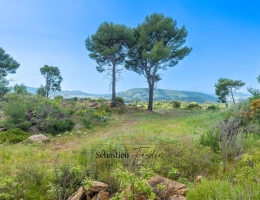
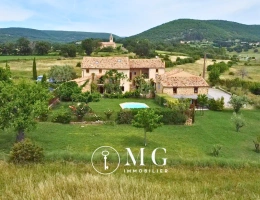
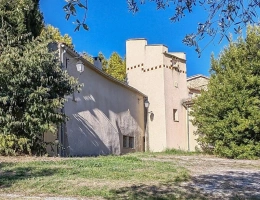
A pig farm for sale in Provence-Alpes-Côte d'Azur is the exception rather than the rule: pig production holds a very small place here, well behind vines, orchards, vegetables and mountain sheep farming. The few businesses that reach the market are almost always modest outdoor or straw-based units, living off direct selling and farmhouse charcuterie. They come to us from farmers winding down, from rural agencies covering the hinterland and from notarial practices, with detail on the buildings, the paddocks and the administrative regime that applies. The national picture can be browsed among the pig farms for sale.
Beyond the listing itself, this page gathers what is usually missing at decision time: land values recorded across the region, where the offer genuinely sits, how to judge a modest set of buildings and the checks specific to this sector. A setting-up project is better prepared in advance: our white paper « Créer une exploitation agricole » (in French) sets out every stage.
Land value drives much of the asking price for a pig farm. French tax transfer statistics (DVF, vineyards excluded) show, for 2025, a median of €13,518/ha in Provence-Alpes-Côte d'Azur, an average of €14,884/ha and 59 sales; 80% of transactions settle between €5,947 and €23,101/ha, against a national median of €5,307/ha.
On the SAFER side, the value of vacant land and pasture is set at €12,260/ha for 2025, moving +2.8% over a year and +12.5% over ten, against €6,460/ha nationally; expect an average discount of 17% where a lease is running.
Here, hectares tell only part of the story. Value sits in the huts and fenced paddocks, the farrowing house where one exists, the dung store or pit and the spreading area that can actually be used, the sow herd and its hardy genetics, self-sufficiency in feed, and above all the processing room with its approval, its drying chamber and its base of market and restaurant customers. To cost your plan, use our financial calculators; to place local land values, open our land price observatory.
The buildings on offer usually bear no resemblance to the specialised houses of western France: movable huts on wooded range, sheds converted into straw-bedded pens, former farm buildings given a new use, occasionally a small slatted unit left over from a modernisation that went no further. Look at how robust the fencing is and whether it keeps wild boar out, at watering during dry spells, shade on the range, the farrowing and weaning space, solid effluent storage, lorry access and handling facilities. On a pig unit of this kind many fittings are home-made: their takeover value deserves to be argued item by item.
The herd is negotiated separately from the walls. Breeding numbers, replacement rate, health status and choice of breed matter more than numerical output, since income comes from the processed product. Add the spreading equipment, any mill and mixer, the trailers and the cold chain. Where the dwelling house comes with the whole, insist on a detailed split between residential property, farm buildings and land: on this coast and in its hinterland the housing share weighs heavily and is not financed like a working tool.
Alpes-de-Haute-Provence (04) and Hautes-Alpes (05) offer the most favourable ground: altitude, oak and chestnut woodland, wide range, more accessible land and a tradition of mountain charcuterie. You will find outdoor units run alongside a sheep flock or a little cereal growing, with simple buildings and distances from dwellings that rarely cause trouble. The trade-off lies in isolation, winter snow cover, summer water supply and the distance to slaughtering facilities, which weighs on how collections are organised and on the cost of every batch sent off.
Var (83) and Alpes-Maritimes (06) confine their rare herds to the hinterland and the upper country, on wooded ground exposed to fire risk and subject to brush-clearing obligations. Closeness to a large body of customers is the main asset, but land is contested, planning documents restrictive and neighbours sensitive to smell as much as to noise. In Bouches-du-Rhône (13), the Crau, the Camargue and the irrigated plains are given over to forage, rice, vegetables and sheep flocks; pig keeping remains anecdotal and the cost of land discourages newcomers.
Vaucluse (84) follows the same logic: the Comtat Venaissin and the slopes of Mont Ventoux live on vines, fruit and vegetables, and the pigs kept there are a sideline on a diversified farm, often supplying a farm shop or a local table. In short, looking for a fattening farm or a breeding unit in this region calls for patience and a flexible brief: better to watch several departments at once, accept starting from a farmstead that needs equipping, and think as much about outlets as about buildings already standing.
Even a small unit falls under the classified installations regime once it crosses a threshold in animal equivalents, through declaration, registration or authorisation depending on the case; a change of operator is notified to the prefecture and the order in force must be read closely, since it fixes capacities and storage requirements. Check that the spreading plan is real, often hard to build where plots are fragmented and wooded, along with any agreements signed with neighbours. Statutory distances from third parties quickly become limiting in communes where scattered housing is spreading.
Biosecurity deserves particular attention on outdoor systems: double fencing, separation from wild boar, an entry room, a loading bay and fallen-stock arrangements govern compliance and, should a disease crisis arise, any compensation. Enquire as well about fire risk, forestry easements and how the plots are zoned in the local planning document, which can forbid extending a building that already stands.
Income on these units rests on direct selling, markets, producer shops, restaurants and sometimes a strong seasonal clientele. A drying room, an approved cutting room, cold rooms and an established goodwill are valued apart from the livestock buildings; health approval does not pass mechanically with the walls and the handover is prepared with the veterinary services. Ask the seller about how seasonal the sales are, a pronounced feature in a region where tourist numbers drive part of the turnover.
Legally, the handover often runs through company shares where the holding is a GAEC or an EARL, with tax and warranty consequences that differ from a straightforward private sale. As soon as land changes hands, the structures control, the French permit system that decides who may farm a given holding, and SAFER's right of pre-emption both come into play, in a region where competition from residential use makes their involvement frequent.
What you see here comes from farmers handing over, from rural property professionals and from notarial offices, with varying levels of detail. Sort by price, by area and by production system, then set an alert: in a region where this kind of holding rarely comes free, early warning changes everything. A broader plan can also be built from the farms for sale in Provence-Alpes-Côte d'Azur.


