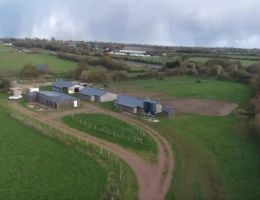
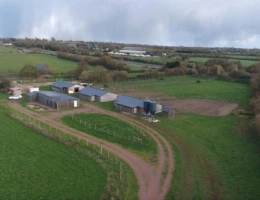
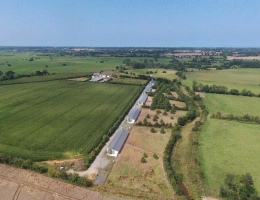
On this page, a sheep farm for sale in Normandy means a working unit — ewes, lambs, buildings, grassland — and not an old farm building sold to be lived in. Normandy remains grass country: sheep occupy the hedged bocage, the slopes and the coastal marshes, sometimes alongside a dairy unit or a wider grass-based system. The listings published here come from farmers handing over, from rural agencies and from notarial offices; they describe the flock, the land and the orientation of the production. They join all the sheep farms for sale in France.
Alongside the listings, this page gives what is needed to prepare a takeover: the value of Norman farmland, the districts where flocks change hands, what to look at on the buildings and the steps to start before signing. To build a setting-up project, lean on our white paper « Créer une exploitation agricole » (in French).
Land weighs heavily on the budget for a sheep farm. Transfers published by the French tax authorities (DVF, excluding vineyards) put the median for farmland in Normandie at €8,305/ha in 2025, with an average of €8,905/ha over 1,442 sales. Eight transactions in ten settle between €5,139 and €13,206/ha, where the national median is €5,307/ha.
A second reference, the SAFER land value benchmark, sets vacant land and pasture at €9,610/ha for 2025, +2.9% in a year and +17.2% over a decade; the French average is €6,460/ha, and a sitting tenant costs a plot roughly 17% of its value.
The area taken on never explains a price on its own. On a Norman ewe flock and its holding, look at the sheep house and its wintering capacity, the lambing pens, the handling facilities, the grass harvesting machinery, the network of fences and hedges, the value of the flock itself and how steadily the lambs are sold. To place all of that, use our land price observatory and our financial calculators.
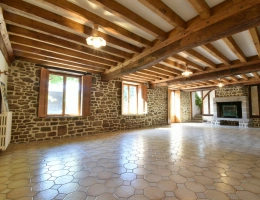
Norman fabric mixes old stone ranges, cattle byres converted into straw-bedded pens and more recent steel-framed sheep houses. On site, inspection covers ventilation, often inadequate in a building designed for cows, the usable height for bedding and mucking out, the space set aside for lambing pens and the presence of a handling race and a loading dock. Fodder reserves, watering and winter access complete the list. A sound set of buildings, away from traffic and easy to work with machinery, sells appreciably above a low, damp shed that has to be put right before the flock even moves in.
Norman flocks are essentially suckler. Local breeds — Avranchin, Cotentin, Roussin de la Hague — survive alongside lowland breeds and terminal crosses, and their hardiness pays in grass-based systems. The buyer examines the lambing period, prolificacy, health status and sales channels. Where the sale includes a house, buildings and land, insist on a breakdown: in Normandy, characterful old fabric attracts residential buyers and can inflate a global price that bears no relation to what the farm can produce.
The Manche (50) is the most sheep-oriented department of the region. Salt-marsh lamb from the bay of Mont-Saint-Michel holds a protected designation of origin, with detailed rules and regulated access to the marsh pastures. Beyond the bay, the Cotentin, the Hague and the Saint-Lô bocage offer good grassland, dense hedges and holdings often modest in size. Land prices stay contained inland but climb sharply near the coast, where residential demand competes directly with farming use.
The Orne (61) continues that grass-based logic: the Perche, the Orne bocage and the Suisse Normande bring together permanent pasture, steep valleys and complete farmsteads, with regular sales and some of the most affordable price levels in the region. The Calvados (14) combines the Bessin, the Pays d'Auge and the wooded south, where grass dominates, with the Caen plain given over to crops; sheep there mainly occupy slopes, valley bottoms and parcels that are never ploughed.
The Eure (27) and the Seine-Maritime (76) form the arable face of the region. On the Neubourg plateau, in the Norman Vexin and across the Pays de Caux, cropping dominates and land is dear: flocks make use of chalk slopes, the Seine banks and cover crops, and conservation grazing is a genuine outlet. The Lieuvin, the Roumois and above all the Pays de Bray to the east keep a more continuous grassland fabric, where livestock farms can still be taken over much as they stand.
A maritime climate and good pasture allow a long grazing season and a system that depends little on bought feed. The other side of that is parasite pressure, ground that carries stock for a shorter autumn, and the constant work of maintaining hedges and fences in the bocage. Grazing the coastal marshes follows rules of its own: authorised periods, stocking limits, tide management and close supervision of the flock. That know-how cannot be improvised and deserves to be passed on by the seller over at least one full season.
The rest of the year turns on rotational grazing, the lambing calendar and the grass harvest, as hay or as wrapped bales. Shearing, foot care and parasite control set the pattern of work, while wool returns little. A flock run organically, under a quality label or under a designation of origin carries rules the buyer must be able to follow from the first cycle onwards.
Taking over land goes through the structures control, the French authorisation required above certain thresholds, and SAFER, the rural land agency, may exercise its pre-emption right over the sale. As much of the Norman area is farmed under tenancy, check the rural leases, their remaining term and the landlord's agreement, together with the reality of the agreements giving access to the marsh pastures where the holding depends on them. Have the transfer of basic payment entitlements, the eligibility of each block and the conditions for the ewe premium confirmed before committing.
Then check flock identification, disease testing results and health status, followed by the regime applying to the building: departmental health regulations or the classified installations rules, depending on numbers and siting. In coastal and suburban communes, make sure the buildings keep an agricultural designation in the local planning document and that extension remains possible given the distance rules to dwellings.
The offers visible here are placed by owners, by Norman rural estate agencies and by notaries. Select by area, by budget or by type of unit, ask to be told as soon as a property matches your criteria, and continue your search across all farms for sale in Normandy.