

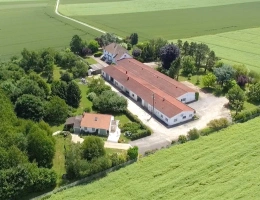
On this page a sheep farm for sale in Île-de-France means a working unit — ewes, lambs, a building, grass — and never an old stone fold offered as a house to restore; the same search carries both intentions and the confusion costs wasted viewings. The region around Paris is above all arable country, and sheep keeping holds a very small place in it, carried by market-edge farms, by contractors who run flocks for conservation grazing and by a handful of livestock farmers settled on the margins of the plateaux. What we list comes from farmers preparing their handover, from rural property firms and from notarial offices, each entry setting out the flock, the fabric and the area controlled. They also appear among our national selection of sheep farms for sale.
Beyond the listings, this page gives what is needed to judge an opportunity: the value of farmland around Paris, the districts where a flock still changes hands, how to read a livestock building and its equipment, and the checks that come with farming in direct contact with a capital city. Our white paper « Créer une exploitation agricole » (in French) covers the setting-up route and the financing side.
Land weighs heavily on the budget for a sheep farm. Transfers published by the French tax authorities (DVF, excluding vineyards) put the median for farmland in Île-de-France at €7,465/ha in 2025, with an average of €7,932/ha over 214 sales. Eight transactions in ten settle between €5,253 and €10,940/ha, where the national median is €5,307/ha.
A second reference, the SAFER land value benchmark, sets vacant land and pasture at €8,190/ha for 2025, +5.7% in a year and +7.5% over a decade; the French average is €6,460/ha, and a sitting tenant costs a plot roughly 17% of its value.
Owned area counts for less here than anywhere else, so scarce and so contested is the land. The worth of a sheep holding in Île-de-France rests more on the building and its bedded area, on handling and transport equipment, on the quality of the flock, on cutting or processing facilities where they exist, and above all on the order book: renewed grazing contracts, a loyal customer base, a secured market stall. Set those items against our land price observatory before costing them in our financial calculators.
Local fabric consists mainly of old farmsteads of the Brie and the Vexin, where a barn has been fitted out to house sheep, with steel-framed sheds added later. Inspection covers air volume and ventilation, the usable height for bedding down and mucking out by tractor, the bedded area that can be opened up at lambing, the lambing pens, the drafting race and a loading dock a lorry can actually reach. Then come straw and forage storage, the water supply and the room to turn a vehicle off a busy departmental road. A building hard against housing calls for a frank assessment of what neighbours will tolerate.
The flock and the machinery make up the rest of the assets. The region gave its name to a prolific meat breed, and the national sheep station at Rambouillet has kept a merino flock there since the closing years of the old monarchy: local farms mix lowland breeds, terminal crosses and hardy animals chosen for grazing parkland. Look at the age of the ewes, health status, how lambing is spread, the condition of the mobile fencing and of the stock vehicle. Where a dwelling is part of the deal, insist on a written breakdown: on this market the house alone is worth far more than the working tool.
Seine-et-Marne (77) holds most of the region's farmland and therefore most of the openings. Beyond the open fields of the Brie and the Multien, grass survives in the Petit Morin valley, in the Bassée along the Seine and on the edges of the Gâtinais, where flocks keep wet meadows and dry calcareous grassland open. Yvelines (78) combines the arable plain of the west with the wooded massif of Rambouillet, where shepherding has a long history, and with the Saclay plateau; farming sits beside protected land that opens up grazing, but property there is fiercely sought after.
Essonne (91) divides between the Beauce, the Hurepoix and the Gâtinais: the valleys of the Essonne, the Juine and the École leave damp bottoms and slopes no plough can take, which sheep grazing keeps open, often in partnership with a local authority or a regional nature park. Val-d'Oise (95) offers the sharpest contrast, between the Plaine de France, given over to arable cropping and squeezed by building, and the French Vexin, whose knolls and valley bottoms shelter a few livestock units and farms open to visitors.
The three inner-ring departments follow another logic altogether. Hauts-de-Seine (92), Seine-Saint-Denis (93) and Val-de-Marne (94) retain almost no farmland, and a sheep base there takes the form of a holding yard attached to a county park, an educational farm or a reclaimed brownfield site. You will practically never take over a farm in the classic sense: what changes hands is a business, grazing agreements, a flock and mobile equipment. Premises are held under a lease or an occupation permit rather than owned outright.
With no upland grazing to fall back on, conservation grazing is the main economic driver here: maintaining urban parks, flood basins, roadside strips, industrial sites or solar arrays under agreement with councils, social landlords or network operators. Income then comes from a service as much as from meat, which changes how a takeover reads: ask for the remaining term of each agreement, how renewal works, when in the year the work falls and how much time goes into hauling animals about. Add everything that comes with publicly used sites, from disturbance of the flock to daily supervision.
Direct selling forms the second pillar of an ewe flock run near Paris: markets, producer shops, box schemes, school catering and neighbourhood butchers absorb steady volumes at prices few grazing regions match. The price of that is logistics: abattoir capacity open to small ruminants is thin in the region and the cold chain ties up equipment. Have the seller spell out where the lambs go, in what form and at what margin.
Planning governs everything. Check how parcels and buildings are zoned in the local plan, whether agricultural construction remains possible and whether development, infrastructure or quarrying schemes cover the holding. Much of the land is rented: read the rural leases, their remaining term, the landlord's position and any environmental clauses. The sale also passes through the structures control, the French authorisation regime for taking over farmland, and through the pre-emption right of SAFER, the rural land agency covering the region.
On the flock side, check the holding register, identification, veterinary follow-up and the regime applying to the building, whether departmental health regulations or the classified installations rules, depending on numbers and siting, with the distance requirements that follow. Add the hazards of the urban fringe: straying dogs, intrusion, theft, walkers crossing grazed parkland and liability after an accident. Insurance, electrified fencing and signage belong to the working tool here as much as the sheepfold itself.
Farmers selling for themselves, agencies specialising in rural property and local notaries keep this page supplied, at the slow pace of handovers in the region. Compare on controlled area, on budget or on the type of outlet, then set an alert, since openings are few and go quickly. Carry your search on through all farms for sale in Île-de-France.


