
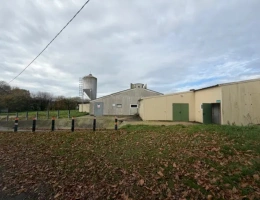
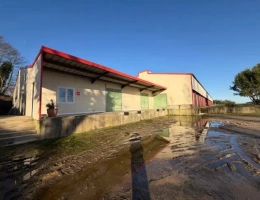
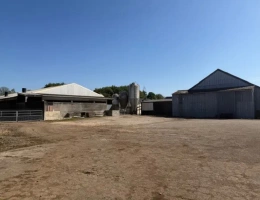
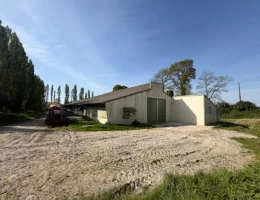
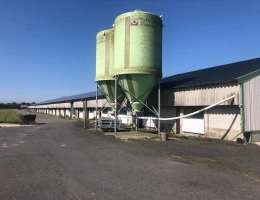
Looking for a sheep farm for sale in Brittany means starting with one clarification: what is on offer here are working ovine businesses, with their flock, their buildings and their grass, rather than old sheepfolds converted into homes. The peninsula is cattle country above all, yet sheep hold a genuine place on its moorland, its inland hills, its islands and the edges of its bays, frequently alongside a second enterprise or a direct-selling activity. Properties reach us from farmers organising their exit, from firms specialising in rural estates and from notarial offices. You will find them among our sheep farms for sale.
Beyond the listing itself, this page sets out what pasture and farmland are worth across the region, which areas genuinely supply the handover market, what deserves attention inside a livestock building and which enquiries to make before committing. If you are putting a setting-up project together, the full route is described in our white paper « Créer une exploitation agricole » (in French).
Land weighs heavily on the budget for a sheep farm. Transfers published by the French tax authorities (DVF, excluding vineyards) put the median for farmland in Bretagne at €5,500/ha in 2025, with an average of €5,803/ha over 1,297 sales. Eight transactions in ten settle between €3,510 and €8,658/ha, where the national median is €5,307/ha.
A second reference, the SAFER land value benchmark, sets vacant land and pasture at €6,540/ha for 2025, +0.3% in a year and +16.8% over a decade; the French average is €6,460/ha, and a sitting tenant costs a plot roughly 17% of its value.
Area alone tells only part of the story on a Breton sheep holding. Weight also falls on the sheepfold and its winter housing capacity, the bedded pen, the handling race and loading dock, the genetic and health standing of the flock, fencing and water supply across parcels that are often fragmented, haymaking equipment, and the outlet: a producer group, a local butcher or sales at the gate. Set those against the figures in our land price observatory, then test how the project balances in our financial calculators.
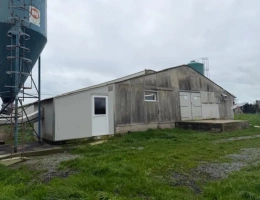
The building governs the winter workload. Check covered area against ewe numbers, ventilation in a bedded shed that often sits low under a damp sky, the roof frame and its covering, rainwater drainage, storage volume for straw and hay, and how easily the shed can be cleared out. Under an oceanic climate, keeping moisture under control matters more than it does inland, because ewes come in early and go out late in the wetter years. A covered sorting pen, a handling race and a well-sited loading dock transform daily life for a farmer working alone, and cost far less bought with the farm than built afterwards.
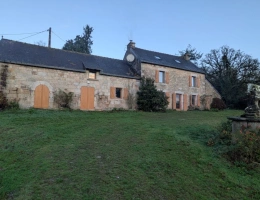
On the flock, ask for ewe and ram numbers, the breeds chosen, the lambing rhythm, the replacement rate, official health qualifications and the veterinary record. A ewe flock handed over with its temporary fencing, shearing gear and feeding equipment spares the incomer an immediate outlay. Where the house, the land and the animals form a single lot, insist on a clear split: in Brittany the residential value of a restored farmstead can outweigh that of the production tool, and the two are not financed in the same way.
Côtes-d'Armor (22) shows the sharpest contrast, between a much sought-after coastline where land changes hands dearly around Lamballe, Dinan and the cap Fréhel headland, and a more affordable inland Brittany, from the Mené hills to the Rostrenen plateau, where moorland, earth banks and permanent pasture suit a grass-based flock. Finistère (29) owes its ovine presence to the monts d'Arrée and the Crozon peninsula, whose heath is grazed, sometimes under agreements to manage protected natural areas; the island of Ouessant gave its name to a local breed now kept mainly as a hobby animal.
Ille-et-Vilaine (35) stands apart through the bay of Mont-Saint-Michel, where salt marshes carry flocks under a protected designation, a demanding system that requires grazing rights and a close reading of the tides. Elsewhere the department mixes mixed-farming units, the bocage of the pays de Fougères and the ring around Rennes, where urban pressure and competition from dairy and arable businesses push land values upward. Sheep units often appear here as a second enterprise, or with new entrants from outside farming families who build on direct sales into a dense local market.
Morbihan (56) completes the picture with the landes de Lanvaux, the inland country around Pontivy and the Brocéliande forest, where poorer grazing finds a coherent use in sheep. Belle-Île-en-Mer keeps up a tradition of grazing its coastal heath, though island life limits farm transactions and complicates logistics. On the mainland, holdings more often come to market as buildings plus land, with part of the area held on tenancy. Along the Morbihan coast, prized for housing, values climb as soon as the dwelling counts for more than the business.
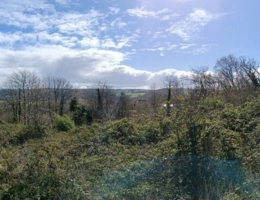
Breton systems rest on grass first: permanent pasture, short-term leys in rotation, heath and grazed natural areas. Study the layout of parcels, commonly fragmented and lined with earth banks, the distance from the yard to the furthest block, how the soils carry stock at the end of winter, and where water is available. A sheep holding with grazing blocks running from the sheepfold gate works quite differently from one scattered across several parishes. Ask the seller how much of the area is owned and how much rented, since that split drives both the asking price and the buyer's security.
On the selling side, nearby towns and heavy summer visitor numbers on the coast open the way to farm-gate sales, producer shops and local butchers, while other flocks deliver through a marketing group. Each route brings its own lambing calendar, finishing requirements and labour pattern. Ask how evenly lambs leave through the year, where the gaps fall, how shearing fits in and what becomes of the wool, which remains hard to value. A flock already matched to its market changes hands far more calmly than one with no buyer lined up.
The administrative regime follows flock size and housing: many sheep units sit under departmental health rules, while the largest move into the classified installations regime, the French permitting system, with distances from dwellings and effluent handling set by prefectural order. Confirm planning consents for the buildings, the drainage arrangements for the house, manure storage capacity and whether the spreading plan matches the available area, a sensitive point in nitrate vulnerable zones where applications are capped. Ask in writing for the flock health record and the treatments carried out.
On land, a farm tenancy continues with the new operator subject to the landlord's agreement, and any purchase remains subject to the structures control, the French authorisation regime for taking over farmland, and to the SAFER's pre-emption right, which is actively used in a region where demand for land outstrips supply. Have grazing agreements over heath or protected areas spelled out, since they do not pass automatically, along with the areas declared for support, which determine entitlement to the ewe premium. A meeting with the chamber of agriculture before you make an offer saves a good deal of backtracking.
Sheep farms listed here move on as owners retire or change direction: private sellers, rural property agencies and notaries add new ones regularly. Set your filters by department, by area or by budget, switch on an alert to catch listings as they go live, and widen the search among the farms for sale in Brittany.