

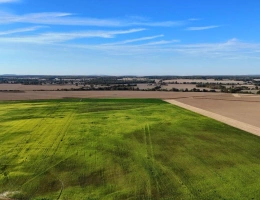
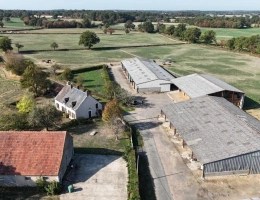
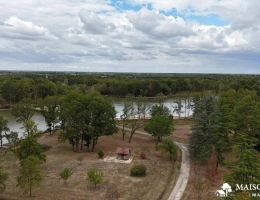
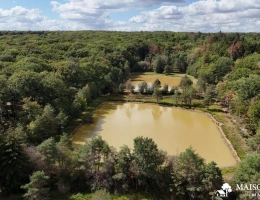
Hunting for a dog kennel for sale in Centre-Val de Loire takes you to a region whose pet-boarding trade lives off both its closeness to Paris and a dense network of country towns. Sites run from family boarding kennels in a former farmstead to hunting kennels inherited from the Sologne, plus a few pedigree dog breeding businesses. Behind the listings stand operators arranging their succession, rural property firms and notaries' offices; each description gives authorised capacity, the type of boxes and the licensing status. You will find them, alongside those of every other region, among our dog kennels and boarding businesses for sale.
Listings alone rarely settle a decision, so this page adds the rest: rural property price benchmarks for the region, the districts where boarding demand holds up all year, the parts of the buildings worth inspecting before an offer, and the French formalities attached to keeping animals commercially. Building from scratch, you will find the funding sequence and the legal set-up covered by our white paper « Créer une exploitation agricole » (in French).
In most sales the dwelling house is the largest single item, ahead of the kennel buildings and the goodwill. According to our country house observatory, the median price of a house in a rural commune in Centre-Val de Loire stood at €150,000 in 2025 (+3.4% year on year), or €1,519/m² of living space, across 10,907 recorded sales. The national median is €189,200.
Past bricks and mortar, the price follows the capacity you can genuinely use, the standard of boxes and runs, the grassed paddocks, the treatment room and the quarantine block, then the business: customer records, how occupancy swings through the year, local reputation and the online booking system. A single block of land, set back from the nearest houses, buys room to expand. Set these markers against our country house price observatory, and price the operation using the financial calculators on the site.
Regional stock runs from a barn converted into a kennel block to modular units laid on a concrete slab. Look at the covered area available per animal, the insulation and ventilation of the sleeping quarters, the fall and watertightness of the floors, where wash-down water drains to, the heating of rest areas and the condition of the run fencing. The number of exercise paddocks, their grass cover and their shade shape how customers judge the place, and therefore the rates it can charge. A kennel with a separate sick bay, an isolation box and a laundry sells well above a site where everything has to be rebuilt.
Most properties combine the working facilities, a dwelling house and sometimes a barn with grass paddocks. Ask for a clear split between real estate, equipment and goodwill: the three are not funded the same way and are not taxed alike. On a breeding operation, the standing of the registered kennel name and the quality of the stock weigh as much as the buildings. A cattery built into the site, by contrast, widens turnover outside the peak weeks and deserves valuing in its own right.
Demand follows the map of towns and trunk roads. Loiret, anchored on Orléans and the motorway down from the Paris region, and Eure-et-Loir, between Chartres and the edge of the capital's commuter belt, draw custom that peaks sharply around French school holidays. Indre-et-Loire benefits from Tours and Loire Valley tourism, with short stays and late bookings. Loir-et-Cher pairs Blois with the Sologne and its second homes, long-standing territory for hunting kennels. Further south, Cher around Bourges and Indre around Châteauroux offer more affordable property and thinner competition.
Those contrasts show in asking prices: boarding kennels near a motorway junction and a dense population sell for more than an isolated site in the Boischaut or the Champagne berrichonne, at equal box capacity. In exchange, a deeply rural takeover often means rebuilding a client list, which is worth raising in your offer. Measure the real driving time from the towns that feed the business, the road signage and the online visibility of the trading name: those explain occupancy gaps better than plot size.
Trading lawfully rests on two things: a person on the premises who holds the ACACED, France's certificate covering the care of companion animals, and an activity entered on the register kept by the department's veterinary service. Past nine weaned dogs housed together, the premises enter the classified installations regime, formality rising with headcount, and a new operator notifies the prefect. Obtain the order in force before committing, since it caps numbers and sets siting rules. The minimum distance from neighbouring dwellings, fixed by departmental sanitary rules, governs any later extension.
Noise remains the leading source of disputes: premises opposed by neighbours can be curtailed by prefectural order or by a nuisance claim, even when properly authorised. Check that local planning allows a boarding use, that the buildings are lawful and, where puppies are sold, the trading registration, the movement register and the identification of every animal. A takeover usually means buying the fonds de commerce, the French legal package covering goodwill, trading name and client base, so confirm that the name, the booking site and the customer file are included.
Three channels feed this page: owners arranging their succession, rural property firms and notaries' offices. Restrict the display to the department you have in mind, the capacity you need or the budget you can commit, schedule an alert so nothing slips past, then widen out to farms for sale in Centre-Val de Loire, among them farmsteads convertible into kennels.


