

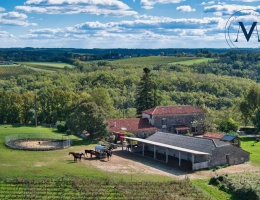

Between the Garonne and Lot valleys and the hills of the Pays de Serres, an equestrian property for sale in Lot-et-Garonne can take many forms. This page lists homes with stables for sale: stone farmhouses with a few boxes and grazing, maisons de maître surrounded by pasture, properties near the bastide towns of Monflanquin and Villeréal, and livery yards around Agen. Private sellers, agents and notaires describe the land area, the number of stables, the facilities and the condition of the house. For comparison, explore all our equestrian properties for sale in France.
Here, price depends first on where the fields lie: valley land, in demand for orchards and crops, costs far more than the hillsides, which usually strike the best balance between acreage and budget for a horse project. The sections below set out price benchmarks, the lie of the land and the precautions to take before buying, and our equestrian property buying guide for France covers the rest of the process.
Two public benchmarks help to place the price of an equestrian property: the value of land and pasture, which carries the acreage, and the price of country houses, which carries the buildings; asking prices of listings complete the picture.
In 2025, 150 farmland sales were recorded in Lot-et-Garonne (DVF data, vineyards excluded): the median price was €7,501/ha and the average €8,547/ha, with 80% of sales between €5,015 and €14,141/ha. Over four years, the median changed by -8.9% compared with 2021. For land and pasture sold free of any lease, the 2025 SAFER scale gives €8,870/ha (+0.3% over one year). By local farming area, values range from €7,730/ha (Coteaux nord du Lot-et-Garonne) to €11,440/ha (Plaines de la Garonne et du Lot). The median is €4,538/ha across the region and €5,307/ha for France as a whole.
For the buildings, the benchmark is the country house: 1,621 sales in rural communes of Lot-et-Garonne in 2025, at a median of €171,000 and €1,640/m², compared with €170,000 in Nouvelle-Aquitaine and €189,200 nationally. For homes of over 300 m², common on larger estates, the regional median reaches €619,000 across 1,221 sales recorded from mid-2020 to the end of 2025.
On 24 September 2026, 16 equestrian properties were for sale in Lot-et-Garonne on ma-propriete.fr. On the same date, the 73 equestrian listings in Nouvelle-Aquitaine showed a median asking price of €649,000, half of them between €458,500 and €847,500, with a median area of 8.2 hectares.
| 2025 benchmark | Lot-et-Garonne (47) | Nouvelle-Aquitaine | France |
|---|---|---|---|
| Farmland: DVF median | €7,501/ha | €4,538/ha | €5,307/ha |
| Land and pasture with vacant possession: SAFER scale | €8,870/ha | €5,770/ha | €6,460/ha |
| Country house: median price | €171,000 | €170,000 | €189,200 |
| Country house: median price per m² | €1,640/m² | €1,657/m² | €1,830/m² |
Sources: 2025 DVF sales (French tax authority) processed by ma-propriete.fr, houses in rural communes; 2025 SAFER land value scale (Agreste, July 2026); homes over 300 m²: DVF mid-2020 to end-2025; asking prices of listings on 24 September 2026. * Indicative value (30 to 99 sales). Not published: fewer than 30 sales or area not covered.
Farmland in Lot-et-Garonne is clearly dearer than in the rest of Nouvelle-Aquitaine and than the French average, pushed up by the Garonne and Lot plains, the most expensive farming area. The northern hills (Coteaux nord du Lot-et-Garonne) are the most affordable and a good starting point for a house with paddocks. Country houses sell close to the regional benchmark and below the national one. Dig deeper with our farmland price observatory or value individual plots using our land value tool.
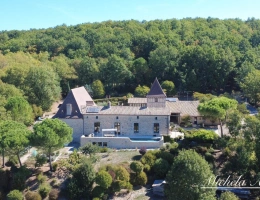
On the slopes of the Pays de Serres, around Duras or in the north of the department, the typical property pairs a stone house, sometimes a maison de maître, with a few hectares of hedged grazing. Outbuildings have often found a new use: a barn fitted with boxes and a tack room, a farm shed turned into a hay barn, a former tobacco-drying barn now sheltering youngstock. A sand arena, paddocks with field shelters and sometimes a lunge pen round off the facilities, for riders who want a few horses on site and a proper family house.
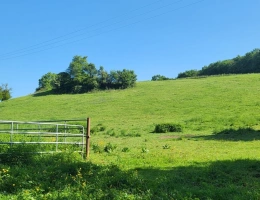
On clay-limestone slopes, check how the ground holds up after rain, which way the fields face and how much shade they get, as summers are hot. Water matters too: a well, a spring or a mains connection in each field saves hauling a tank. Finally, make sure a lorry can reach the yard, since some hillside lanes are narrow and steep.
Around Agen, Marmande and Villeneuve-sur-Lot, the market also includes livery yards with an indoor school, a horse walker and a wash bay. Riding schools and pony clubs to take over come up from time to time, with a clubhouse and a local clientele. In the valleys, some horse farms occupy former farm holdings whose buildings adapt well to horses. An equestrian centre for sale in Lot-et-Garonne is judged on its clients, the terms on which it uses its land and its facilities as much as on its acreage. Equestrian gîtes are rarer and aimed at trail riders.
The department divides between the broad Garonne and Lot valleys, whose plains are planted with orchards, including the Ente plums that become pruneaux d'Agen, and gentler uplands: the Pays de Serres north of Agen, the Duras hills to the north-west and the northern coteaux towards the bastides of Monflanquin and Villeréal. Beyond Nérac to the south-west, the land gives way to the pine forests of the Landes de Gascogne. For horses, the hills offer cheaper grassland, while the plains stay devoted to fruit and field crops.
On the edge of Agen, La Garenne racecourse at Le Passage holds race meetings, and Agen station is served by TGV. The A62 motorway follows the Garonne between Bordeaux and Toulouse, bringing both cities within reach. The department also attracts British and Dutch buyers, and its northern edge is not far from Bergerac airport and its flights to the UK.
In the valleys, Garonne and Lot floods can cover the fields: the commune's flood risk plan shows the areas concerned and the building rules. On the hills, clay soils swell and shrink with the seasons and can crack older buildings, so a thorough survey is worthwhile. Dry summers call for hay and water reserves. Near bastides and listed buildings, the heritage architect (Architecte des Bâtiments de France) gives an opinion on any indoor school or stable block, and the local plan (PLU) may restrict building in farming zones.
Check exactly which land is being sold. Grazing the seller rents from other owners stays outside the transaction: the new owner has to obtain a lease in their own name from each landlord, with no guarantee of success. The existing lease cannot be transferred to the purchaser, apart from the uncommon transferable lease (bail cessible) and particular situations between close relatives. The SAFER holds a pre-emption right over farmland, and livery or breeding normally falls under the agricultural regime, with MSA membership linked to how large the activity is.
Listings from private sellers, agents and notaires across Lot-et-Garonne are gathered on ma-propriete.fr. Sort them by acreage, stabling or facilities such as an indoor school, and switch on an e-mail alert for new arrivals. We also post properties on Facebook, in the group « Propriétés équestres à vendre - ma-propriete.fr ». Also considering Dordogne, Gironde or Landes? Broaden your search to equestrian properties for sale in Nouvelle-Aquitaine.
Own a house with stables, a livery yard or a horse farm in the department? Advertise your property with photos, a plan of the plots and a description of the facilities. The location shown can be exact or limited to the area, which keeps a running business discreet. On request, we refer you to specialists in rural property and assess your land in a valuation study.