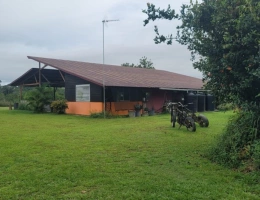
A farm for sale in French Guiana resembles nothing else in France: a market-garden unit on the coastal plain, a tropical orchard on the higher ground of Roura, a cattle holding grazed on savannah near Mana, a block of cane in the west or a forest plot cleared for food crops. Buying here begins with knowing where the land came from: clearance, the road serving the site and the water point weigh as much as soil quality. The listings gathered here spell that out, along with the equipment and plantings transferred; they are placed by growers stopping work, by coastal property professionals, by notarial offices and by advisers who specialise in handovers. They round out the picture we draw of farms for sale in France.
Mainland French land prices give no useful benchmark here: the Guianese market rests on different mechanisms, where land usually comes from the State rather than from a sale between private owners, and each property is judged on its access, its clearance and its title. This page brings together what matters before committing: the productions of the territory, the districts where supply exists and the checks to carry out. The route a project holder follows, from the choice of legal status through to funding, is described step by step in our French-language white paper « Créer une exploitation agricole ».
Farming in French Guiana feeds the territory first. Market gardening leads the way along the coastal belt, around Macouria, Matoury, Roura and the farming villages of the west, with a range of tropical and temperate vegetables grown under cover or in the open. Fruit growing follows, built on citrus, pineapple, lychee, rambutan and passion fruit, often combined with vegetables on the same holding. Sugar cane and its distillation survive in the west, and a few specialist crops complete the picture.
Livestock rests mainly on beef cattle, grazed on improved pasture or on the savannahs of the coastal plain, using breeds suited to an equatorial climate; pig and poultry units near the towns add to this. Traditional forest plots, worked along the rivers and in the interior, belong to a different logic from the property market and rarely change hands by sale. For a buyer, a working farm is worth here what its road access, its water point, its degree of clearance and its route to market make it.
French Guiana (973) makes up the region on its own, and almost all farming is concentrated on a narrow coastal belt. The centre, around Cayenne, Matoury, Rémire-Montjoly and Macouria, holds the vegetable and fruit holdings closest to the markets and to distribution: land there is contested by urban growth and available areas are becoming scarce. Inland, Roura, Montsinéry-Tonnegrande and the Cacao district carry larger units, with orchards and food crops on higher ground.
The west, from Kourou to Saint-Laurent-du-Maroni by way of Sinnamary, Iracoubo and Mana, forms the second farming pole. It has the largest areas, cattle grazed on savannah, the former rice fields of the Mana plain, sugar cane and vegetable-growing districts built up by long-established communities. Distance to market, the state of the tracks and access to electricity weigh as heavily as soil quality in the value of a property.
The east, from Régina to Saint-Georges-de-l'Oyapock, remains lightly equipped and farming there is scattered. The interior communes — Maripasoula, Grand-Santi, Papaïchton, Camopi — live on forest plots and food crops outside any land market. Supply genuinely available to buy is therefore confined, in the main, to the coastal belt: it comes from retirements, from abandoned projects and, more often, from land allocated by the State to a project holder.
Almost the whole territory belongs to the private domain of the State, which changes entirely how land is obtained. Alongside the open market, limited to the already privatised parcels of the coast, setting up usually means applying for the transfer or concession of agricultural land, handled by the State services and by the regional land and development agency, with a development schedule to meet and a probationary period before final title is granted. A solid, costed project backed by professional qualification then counts for far more than a financial offer.
Before buying bare farmland, establish exactly what right is being sold: freehold, a concession under way, tolerated occupation or a simple authorisation. Clearing forest requires consent, wetlands and river margins are protected, and part of the territory falls within regulated perimeters. Past gold-mining activity in certain districts finally warrants close attention to soils and watercourses.
Working the area acquired also calls for an administrative permit, examined under the rules governing farm structures; the regional planning document sets thresholds and priorities tuned to Guianese conditions, with a clear advantage given to new entrants and to keeping units viable. The application runs in parallel with the purchase and should be settled before anything firm is signed.
Ground that is already rented does not come free with the sale: whoever farms it stays put and ranks first among buyers, even where nothing was ever put in writing. In a territory where occupation without title is not rare, a survey of buildings, fences, tracks and perennial plantings forms part of the examination. An agricultural property already farmed by a third party is not financed in the same way as one free of occupation.
Along the Guianese coast, sellers are rarely numerous at the same moment: farmers winding down, project holders giving up, families deciding between several parcels, supported by the agencies and notarial offices of Cayenne, Kourou and Saint-Laurent. Their listings arrive as handovers occur. Sift them by commune, by type of production, by extent or by budget, and have a mail notice sent to you whenever a posting answers your plans. On the selling side, publication is done independently, from a listing written out in detail. To widen the search, browse farms for sale in France.