

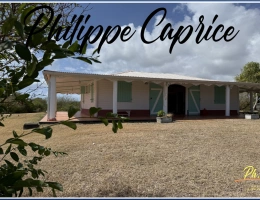
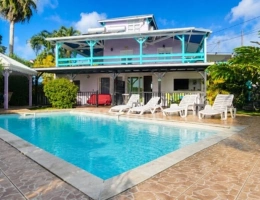
A farm for sale in Martinique rarely comes as a large holding in one block: the island works with tight parcels, sharp relief and highly specialised systems, from the bananas of the Atlantic north to the cane of the central and southern plains. The succession market is narrow and openings are few, which makes early preparation decisive for a serious buyer. The offers published here come from growers handing over, from island estate agencies, from notarial offices and from handover advisers; they set out the area farmed, the agronomic quality of the soils, the local planning classification and the production assets transferred. They take their place in our selection of farms for sale in France.
The material below is meant to inform the decision: the sectors that hold the territory together, the districts where a holding occasionally comes free, the verifications to carry out before any offer. Mainland French farmland price benchmarks carry no weight here, as the island market answers to a scarcity and to planning rules of its own. To build an entry project, our French-language white paper « Créer une exploitation agricole » runs through the legal structure and then the funding package.
Two export sectors structure Martinican farming. Bananas, organised through producer groups, occupy the humid slopes of the Atlantic north and part of the centre; this is labour-intensive fruit growing, with packing stations and port logistics built into the holding. Cane supplies the sugar works and the distilleries under an appellation of origin that governs agricultural rum and adds clear value to classified parcels. Taking on either system calls for investment capacity and technical skill that bear no relation to the headline area.
Alongside them, food and diversification crops supply the local market: market gardening on the cooler hills, traditional roots and tubers, citrus and avocado, tropical flowers and specialist crops under cover. Livestock remains scattered and is mostly run as mixed farming, with creole cattle herds, goats, a few pig units and poultry in small enterprises. These diversification units steady the cash flow of a holding whose main income depends on a single export crop.
A single-department region, Martinique (972) shows clearly separate production areas. The Atlantic north, from Macouba to Sainte-Marie by way of Basse-Pointe and Le Lorrain, is the banana heart of the island, on deep, well-watered volcanic soils. The Caribbean north, around Saint-Pierre, Le Carbet and Le Prêcheur, combines fruit crops, hillside market gardening and small livestock units on the flanks of Montagne Pelée.
The centre, with the Lamentin plain and Le Robert, brings together cane, vegetables and livestock on the flattest ground, but also faces the strongest competition from housing and business zones. The south, from Le François to Le Vauclin and from Rivière-Pilote to Sainte-Anne, mixes cane, extensive grazing and food crops on drier hills where water supply becomes the limiting factor.
Supply renews itself slowly, mostly through retirements and family partitions. Coastal parcels and land at the edge of the towns are the most contested and the least available; the inland and southern hills offer more area, with access, slope and irrigation constraints that need costing before any commitment. A buyer seldom assembles an acreage in one transaction.
No purchase makes sense here without soil analysis. Historic chlordecone contamination affects part of the former banana land and determines which crops are possible, particularly roots and tubers and any livestock grazing at ground level. Ask for parcel-by-parcel analysis results, the cropping history and, where relevant, the land's inclusion in the public monitoring and support schemes set up for affected farmers.
Add the scarcity of land, the undivided estates that freeze many parcels, the special regime applying to the coastal strip, erosion on steep slopes and cyclone risk. A working farm is judged here on its soils and its access as much as on its shelters, its irrigation network and buildings designed to stand up to high winds. The outgoing farmer's insurance policy and the record of claims over recent seasons give a fair measure of how exposed the site really is.
The notary reports agricultural sales to SAFER Martinique. The agency can exercise pre-emption and then pass the land to whichever applicant it prefers, weighting new entrants and the consolidation of viable businesses. Letting it know about a project early remains the surest way to avoid an unwelcome turn after the preliminary contract, and to reach properties placed directly with the land agency.
Farming the land also requires an authorisation assessed against the regional farm structure plan. Check actual occupancy last: written rural leases, long-standing agreements and merely tolerated occupation are all common, and an agricultural property already farmed by a third party offers neither the same availability nor the same financing terms as a vacant one. A joint inventory drawn up before the offer prevents a good deal of dispute over plantations and fixed improvements.
Growers handing over, estate agencies and Martinican notaries entrust their instructions to this page as takeovers arise. Pick the commune, the sector, the area or the budget that suit you, then switch on an e-mail alert to hear on the day a matching property appears. Handing over your own holding? A few minutes are enough to publish a listing. To widen the horizon, browse farms for sale in France.


