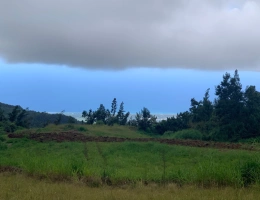
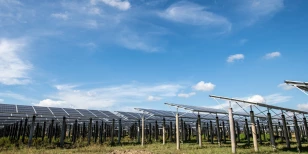
A farm for sale in Réunion resembles nothing found on the French mainland: plots stacked from the coast up to the highlands, areas measured in hectares rather than tens of hectares, and systems built around sugar cane, livestock and tropical crops. Generational handover is a constant concern on an island where cultivable land is scarce and every purchase plays out within a narrow perimeter. The listings collected here come from planters handing over their business, from estate agencies based on the island, from notarial offices and from specialist advisers; they state the area under cultivation, the planning classification, the occupancy arrangement and the equipment sold with the land. They join our nationwide selection of farms for sale in France.
What follows is what a decision rests on: the productions that frame the island, the districts where holdings change hands, the checks to run before an offer. Mainland French farmland price benchmarks carry no practical meaning here, since scarcity, insularity and local planning rules create a market of its own. To build an entry project, the white paper « Créer une exploitation agricole » (in French) covers every stage, from company structure to funding.
Sugar cane still takes up most of the cultivated area and frames the island's farm economy, from the eastern lava plateaux to the southern and western slopes. Around it, high-value specialist crops have grown up: vanilla on the windward coast, rose geranium and vetiver in the western highlands, turmeric and aromatic plants in the wild south. Their acreages stay modest, but the outlets are established and the supply chains organised.
Livestock forms the second pillar, largely structured into organised sectors: dairy and beef cattle on the Plaine des Cafres and the Plaine des Palmistes, pigs and poultry in housed units across the island, frequently combined with upland pasture in mixed farming systems. Upland market gardening and fruit growing, from lychee and mango to pineapple and citrus, supply a home market facing little competition on fresh produce.
A single-department region, Réunion (974) packs into one territory environments that elsewhere would span several departments. The windward coast, from Saint-André to Sainte-Rose, concentrates cane, shade-grown vanilla and tropical fruit on deep soils under generous rainfall, with Bras-Panon, Sainte-Suzanne and Saint-Benoît among its most farmed communes. The south, around Saint-Joseph, Petite-Île and Le Tampon, mixes lowland cane with market gardening and livestock units as soon as the altitude rises.
The west and south-west, from Saint-Paul to Saint-Louis, combine irrigated cane on the plateaux, dry crops on the savanna and perfume plants in the highlands. The cirques of Salazie and Cilaos live on niche crops grown on steep ground, from chayote to lentils, on tiny and often landlocked parcels. The interior highlands are the domain of permanent pasture and suckler herds.
Supply is scarce everywhere and renews itself mainly through retirements. The urbanised lowlands, from Saint-Denis to Saint-Pierre, face direct competition from housing, public facilities and business parks; the highlands offer more land, but demanding working conditions, awkward access and buildings that often need taking in hand. Fragmentation is the rule: holdings in a single block are rare, and a buyer usually assembles an acreage in several stages.
The first obstacle is legal: a great deal of land remains held in undivided succession, sometimes across several generations, which blocks sales and forces a buyer to rebuild the chain of title before committing. Have the origin of ownership checked, along with any formal partition and the nature of informal occupation, which is common on family parcels. A contract signed without that review often ends in months of proceedings.
Then come the physical constraints: slope and erosion, irrigation perimeters and water rights attached to collective networks, farmland zoning protected by regional planning documents, proximity to the national park core, and cyclone exposure that governs how buildings and shelters are built. A working farm is judged here on its access, its irrigation and its glasshouses as much as on its declared area.
Every sale of agricultural land passes through a notification to SAFER Réunion, the land agency entitled to pre-empt and then reallocate the ground to whichever application it judges strongest, with a marked preference for new entrants. On land this contested, lodging a file well before a property comes to market is all but compulsory. The chamber network and the dedicated new-entrant advice points round out the route, particularly for the takeover appraisal and the investment budget.
Farming the land also calls for an authorisation granted in the light of the regional structure plan, a document that sets area thresholds and priorities around the small scale of island holdings. Check the occupancy position last: historic share-farming arrangements, written rural leases and long-standing verbal agreements do not offer the same guarantees, and an agricultural property already occupied is not easily recovered.
Retiring planters, estate agencies and notaries across the island post their instructions here as handovers come up. Sort by commune, by production, by area or by budget, then switch on an e-mail alert: as soon as a property fits your search, word reaches you. Handing over your own holding? Publishing a listing takes a few minutes. To see how the island compares with other territories, browse farms for sale in France.